 87db167d7f
The previous approach of mounting cri-base.json into kind nodes failed because we didn't tell containerd to use it via containerdConfigPatches. RuntimeClass allows different stacks to have different rlimit profiles, which is essential since kind only supports one cluster per host and multiple stacks share the same cluster. Changes: - Add containerdConfigPatches to kind-config.yml to define runtime handlers - Create RuntimeClass resources after cluster creation - Add runtimeClassName to pod specs based on stack's security settings - Rename cri-base.json to high-memlock-spec.json for clarity - Add get_runtime_class() method to Spec that auto-derives from unlimited-memlock setting Co-Authored-By: Claude Opus 4.5 <noreply@anthropic.com> |
||
|---|---|---|
| .gitea/workflows | ||
| .github/workflows | ||
| docs | ||
| scripts | ||
| stack_orchestrator | ||
| tests | ||
| .gitignore | ||
| .pre-commit-config.yaml | ||
| CLAUDE.md | ||
| LICENSE | ||
| MANIFEST.in | ||
| README.md | ||
| pyproject.toml | ||
| pyrightconfig.json | ||
| requirements.txt | ||
| setup.py | ||
| tox.ini | ||
README.md
Stack Orchestrator
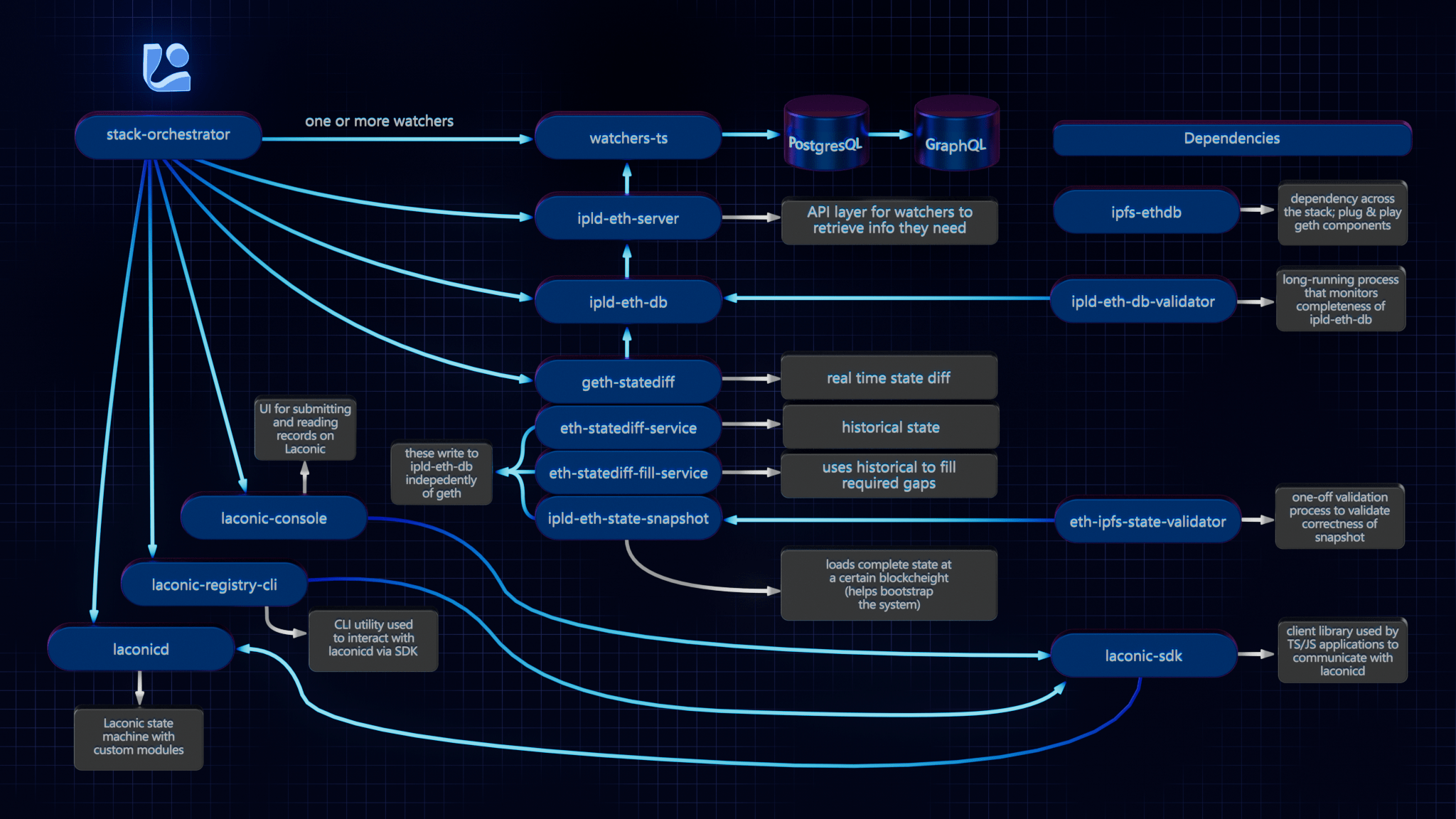
Stack Orchestrator allows building and deployment of a Laconic Stack on a single machine with minimial prerequisites. It is a Python3 CLI tool that runs on any OS with Python3 and Docker. The following diagram summarizes the relevant repositories in the Laconic Stack - and the relationship to Stack Orchestrator.
Install
To get started quickly on a fresh Ubuntu instance (e.g, Digital Ocean); try this script. WARNING: always review scripts prior to running them so that you know what is happening on your machine.
For any other installation, follow along below and adapt these instructions based on the specifics of your system.
Ensure that the following are already installed:
- Python3:
python3 --version>=3.8.10(the Python3 shipped in Ubuntu 20+ is good to go) - Docker:
docker --version>=20.10.21 - jq:
jq --version>=1.5 - git:
git --version>=2.10.3
Note: if installing docker-compose via package manager on Linux (as opposed to Docker Desktop), you must install the plugin, e.g. :
mkdir -p ~/.docker/cli-plugins
curl -SL https://github.com/docker/compose/releases/download/v2.11.2/docker-compose-linux-x86_64 -o ~/.docker/cli-plugins/docker-compose
chmod +x ~/.docker/cli-plugins/docker-compose
Next decide on a directory where you would like to put the stack-orchestrator program. Typically this would be
a "user" binary directory such as ~/bin or perhaps /usr/local/laconic or possibly just the current working directory.
Now, having selected that directory, download the latest release from this page into it (we're using ~/bin below for concreteness but edit to suit if you selected a different directory). Also be sure that the destination directory exists and is writable:
curl -L -o ~/bin/laconic-so https://git.vdb.to/cerc-io/stack-orchestrator/releases/download/latest/laconic-so
Give it execute permissions:
chmod +x ~/bin/laconic-so
Ensure laconic-so is on the PATH
Verify operation (your version will probably be different, just check here that you see some version output and not an error):
laconic-so version
Version: 1.1.0-7a607c2-202304260513
Save the distribution url to ~/.laconic-so/config.yml:
mkdir ~/.laconic-so
echo "distribution-url: https://git.vdb.to/cerc-io/stack-orchestrator/releases/download/latest/laconic-so" >  ~/.laconic-so/config.yml
Update
If Stack Orchestrator was installed using the process described above, it is able to subsequently self-update to the current latest version by running:
laconic-so update
Usage
The various stacks each contain instructions for running different stacks based on your use case. For example:
Contributing
See the CONTRIBUTING.md for developer mode install.
Platform Support
Native aarm64 is not currently supported. x64 emulation on ARM64 macos should work (not yet tested).